
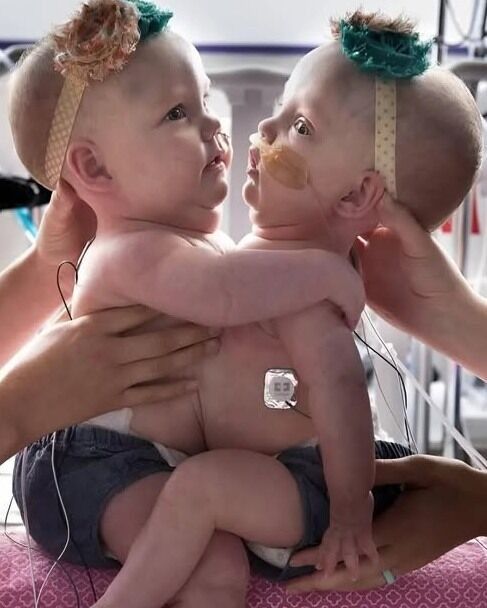
Born Joined at the Chest and Abdomen: How Modern Medicine Gives Conjoined Twins a Second Chance at Life
Conjoined twins have always captured the world’s attention—not because their stories are “shocking,” but because they represent some of the most extraordinary medical challenges and the most inspiring examples of human resilience. When twins are born joined at the chest and abdomen, the journey ahead is complex, emotional, and filled with uncertainty. Yet thanks to modern medical advances, many pairs of conjoined twins have been successfully separated and gone on to live healthy, independent lives.
This is an article about hope, science, and the incredible teams who make the impossible possible.
What It Means to Be Born Conjoined
Conjoined twins occur when identical twins begin to separate during early development but do not fully divide. Depending on where they are joined, they may share:
Skin, muscle, and bone
Vital organs (such as the liver or heart)
Blood vessels
Digestive or respiratory structures
Twins joined at the chest and abdomen—called thoraco-omphalopagus twins—are among the most common forms. Their care requires precision and extraordinary teamwork.
The First Steps: Life-Saving Care After Birth
Once conjoined twins are born, doctors work quickly to understand exactly how their bodies are connected. This involves:
Detailed imaging (MRI, CT scans)
Cardiac evaluations
Organ mapping
Nutritional and breathing support
In many cases, the first days are focused on stabilization. Many families are surprised to learn that separation surgery usually doesn’t happen immediately—the twins often grow for months so they’re stronger and healthier before facing such a complex procedure.
The Separation Surgery: A Medical Marvel
Separation surgeries can involve dozens of specialists, including:
Pediatric surgeons
Cardiologists
Liver and thoracic surgeons
Anesthesiologists
Reconstructive surgeons
Critical care teams
These operations often last many hours, and every step is mapped out in advance using 3D models and computer simulations. When twins share major organs—especially the liver—surgeons must skillfully separate tissues, repair structures, and reconstruct the areas so each child can thrive independently.
Life After Separation: Stronger Than Ever
The recovery period can be long, but many separated twins:
Learn to sit, crawl, and walk independently
Grow up to attend school
Develop their own personalities and interests
Enjoy active, healthy lives
ADVERTISEMENT
