
Plan your best garden yet! This printable 2026 Sowing Calendar tells you exactly when to plant your favorite vegetables, herbs, and flowers for a thriving garden all year long.
Website
Your Email…
Get My FREE Calendar
We use your personal data for interest-based advertising, as outlined in our Privacy Notice.
This self-seeding annual reseeds in early spring if allowed and offers tall, spiky blooms in shades of blue, purple, white, and even blazing red.
4: Poppies (Papaver Spp.) (USDA Zone 3-8)
Oriental Poppies
Poppies
Poppies offer delicate and colorful blooms in colors like red, orange, pink, and white. They grow best when allowed to drop seeds in place and return year after year with their bright flowers.
5: Sweet Alyssum (USDA Zone 7-11)
Sweet Alyssum
Sweet Alyssum
Alyssums are low-growing annuals that not only offer the most beautiful and delicate-looking flowers but also a sweet fragrance to accompany them. These flowers can bloom for months and self-seed generously.
6: Cosmos (USDA Zone 7-10)
Cosmos
Cosmos
Cosmos are extremely underrated when it comes to flower texture and beauty. The tall, airy flowering annual offers daisy-like blooms and self-seeds pretty easily. The thing I love about cosmos is that they even thrive in poor and unfavorable soil conditions.
🌱 Get Your FREE 2026 Sowing Calendar! 🌱
Plan your best garden yet! This printable 2026 Sowing Calendar tells you exactly when to plant your favorite vegetables, herbs, and flowers for a thriving garden all year long.
We use your personal data for interest-based advertising, as outlined in our Privacy Notice.7: Coreopsis (USDA Zone 5-9)
Coreopsis (Coreopsis lanceolata)
Coreopsis
Although coreopsis flowers may not exactly be known for their reseeding qualities, there are certain varieties of this annual, however, that reseed freely and yield yellow daisy-like flowers.
8: Cornflowers (Centaurea Cyanus) (USDA Zone 3-8)
Centaurea Cyanus
The cornflowers is a classic blue wildflower that not only attracts pollinators like bees and butterflies to the garden effectively, but also spreads fast through seed.
9: Black-Eyed Susan (Rudbeckia Hirta) (USDA Zone 4-9)
Rudbeckia fulgida Black-Eyed Susans
Black-Eyed Susans
I’ve said this many times in my previous articles that black-eyed Susans resemble sunflowers for me. And, from a distance, they actually do. The sunny yellow petals combined with the dark center is a classic look that can elevate the vibe of any garden.
Black-eyed Susans reseed well and attract bees to the garden, which helps improve the garden ecosystem.
10: Verbena Bonariensis (USDA Zone 7-11)
Verbena
🌱 Get Your FREE 2026 Sowing Calendar! 🌱
Plan your best garden yet! This printable 2026 Sowing Calendar tells you exactly when to plant your favorite vegetables, herbs, and flowers for a thriving garden all year long.We use your personal data for interest-based advertising, as outlined in our Privacy Notice.
Weirdly, it’s been a very long time since we’ve discussed verbenas here. This plant is tall and airy, offering blooms in bright shades of pink and lavender.
As long as there’s some warmth to work with, verbenas can self-seed quite easily and effectively, spreading and giving your garden that special pop of color when they bloom.
11: Cleome (Spider Flower) (USDA Zone 7-11)
Cleome
Cleome
Cleomes tend to grow tall with dramatic pink or white blooms. They self-seed generously but may need some thinning to get going.
Conclusion
Self-seeding wild flower garden
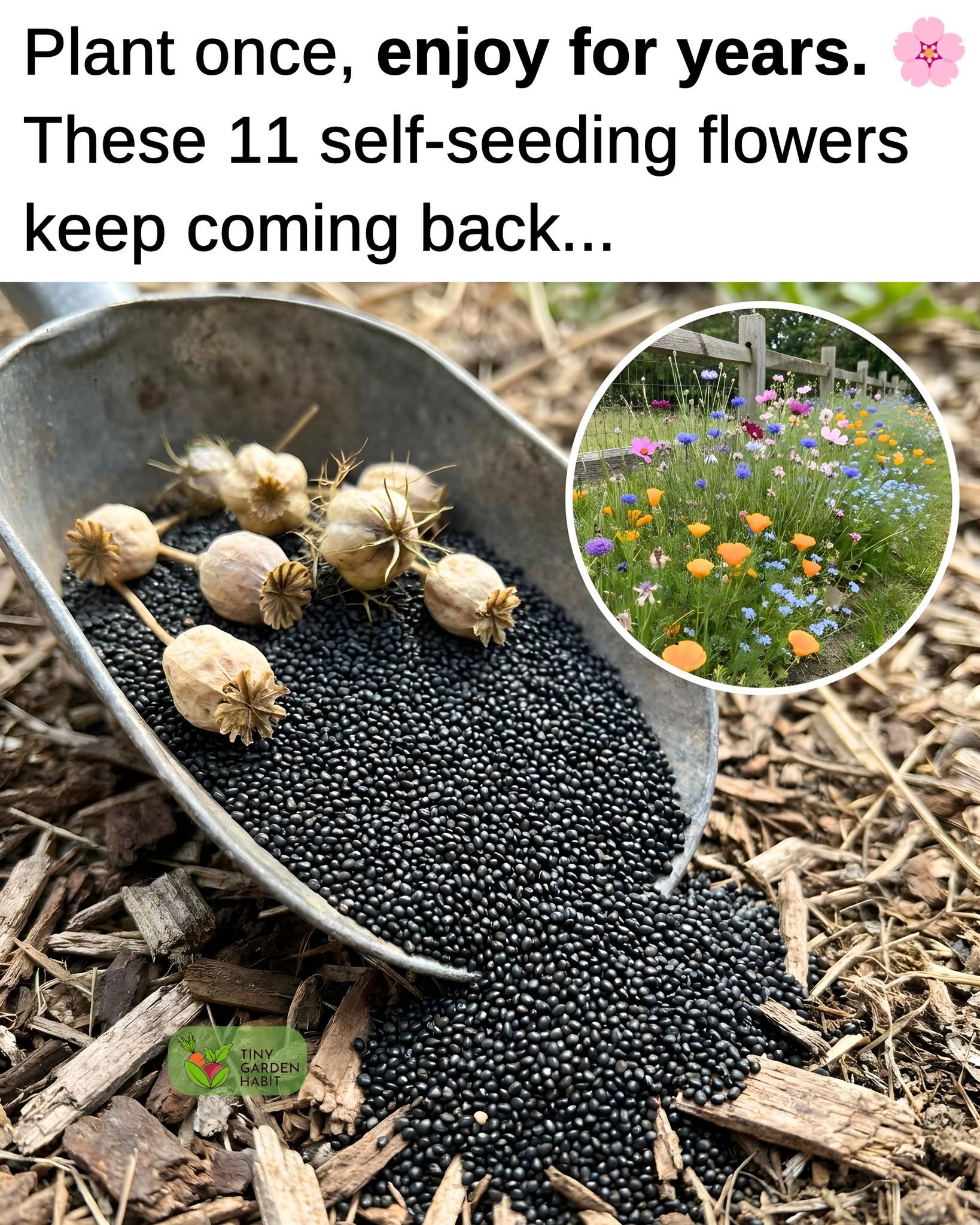
So, there you go, your detailed guide on self-seeding flowers! These flowers will add continuous color to your garden, and some of them are just as good at attracting pollinators, simultaneously benefiting the garden ecosystem.
Although you need to be a little more careful and attentive when handling self-seeding flowers, the tiny bits of effort seem worth it when you consider how effortlessly they grow on their own without needing to be replanted every year.
ADVERTISEMENT

