
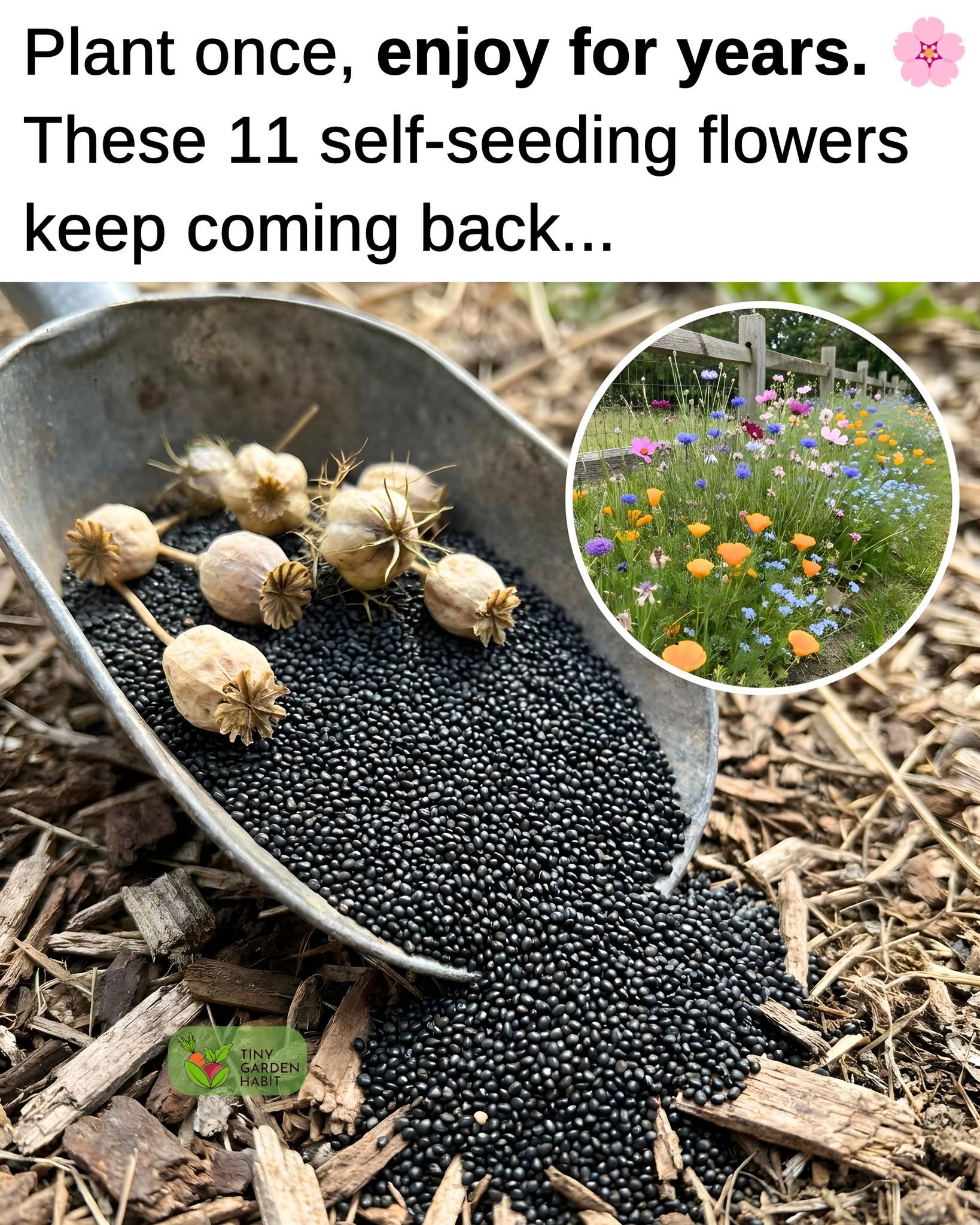
When I first started getting into gardening, I remember my mom was visiting me at the time, and she told me about self-seeding flowers that she and grandma used to grow and love.
If you’re an extremely busy or lazy person, you’ve got to learn about self-seeding flowers, as they might quite literally change your life!
Let’s discuss these flowers in detail, shall we?
What Are Self-Seeding Flowers? Are They Important?
Poppy seeds
Well, in the simplest words, self-seeding flowers drop seeds at the end of their blooming cycle, grow new plants by themselves, and return year after year without needing to be replanted.
What makes self-seeding flowers so important and special is the fact that they help you save loads of time and money, which otherwise would have been spent on replanting new plants every season.
Here’s How To Encourage Self-Seeding in Your Garden
wild flower mix garden (self-seeding)
🌱 Get Your FREE 2026 Sowing Calendar! 🌱
Plan your best garden yet! This printable 2026 Sowing Calendar tells you exactly when to plant your favorite vegetables, herbs, and flowers for a thriving garden all year long.
Website
Your Email…
Get My FREE Calendar
We use your personal data for interest-based advertising, as outlined in our Privacy Notice.
If you want to promote self-seeding activity in your garden, it’s very important that you:
Avoid deadheading all flowers and actually let seed heads mature and drop on their own;
Limit mulch around reseeding areas like the base of the flowering plant as much as possible;
Try your best not to disturb the soil a lot, or else the self-seeding process may get hindered.
11 Self-Seeding Flowers For Effortless Seasonal Color
Self-seeding flower garden
Note: The USDA zones listed below refer to where these flowers self-seed most reliably, not the only zones where they can be grown. Most of these varieties can be grown as annuals in nearly all regions of the country, but their ability to reseed successfully depends on local climate conditions.
1: Calendula (USDA Zone 6-10)
Calendula
Calendula
Calendulas offer mesmerizing, bright orange and yellow blooms. The vibrant annual flower reseeds easily and grows best when outside temperatures are on the cooler end of the spectrum.
2: Nigella (Love-In-A-Mist) (USDA Zone 5-9)
Nigella (Love-In-A-Mist)
Nigella
Nigella flowers are typically shimmering white or blue in color, with decorative seed pods that allow for efficient reseeding. They’re great for naturalizing.
3: Larkspur (USDA Zone 4-8)
Larkspur (Consolida Ajacis)
Larkspur
🌱 Get Your FREE 2026 Sowing Calendar! 🌱
For Complete Cooking STEPS Please Head On Over To Next Page Or Open button (>) and don’t forget to SHARE with your Facebook friends
ADVERTISEMENT

