
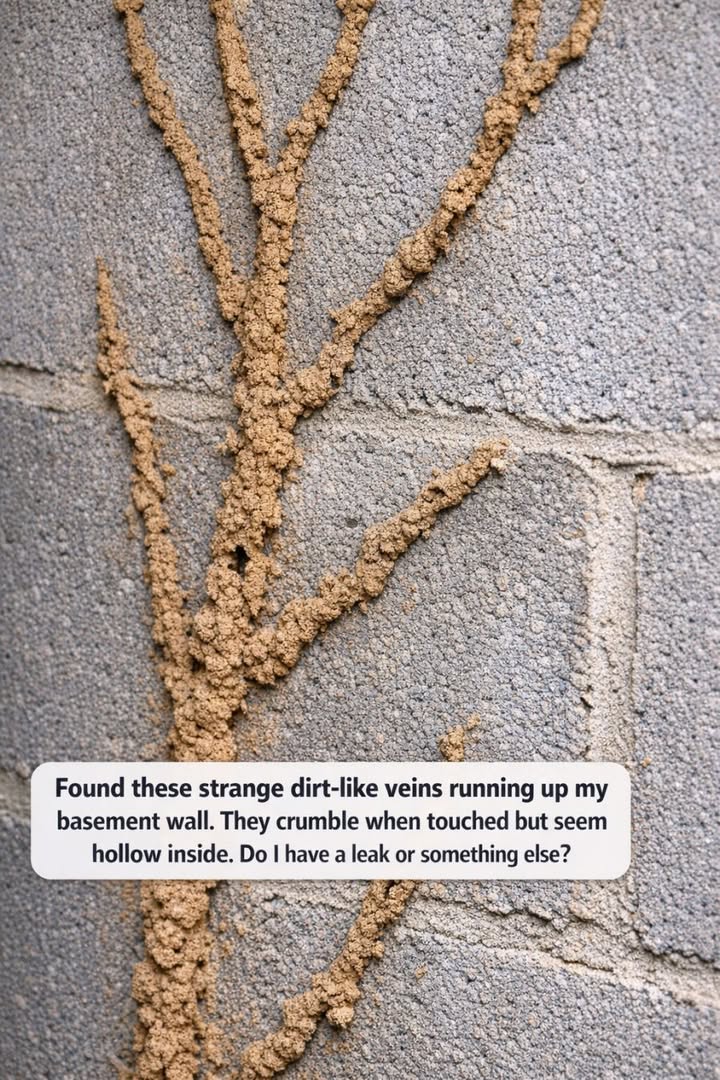
Discovering strange dirt-like veins on your basement wall can be alarming. They appear to climb upward, defying gravity, and crumble at the slightest touch, revealing their hollow interiors. Such a discovery naturally leads to concern about potential leaks or structural issues. However, the true nature of these formations may be more insidious than a simple plumbing problem.
In many cases, these dirt-like veins are not indicative of water damage but are instead a sign of a potential termite infestation. Understanding what these formations are and how to differentiate them from other benign issues is crucial in protecting your home. This article will guide you through identifying, testing, and addressing these curious formations to ensure your basement remains safe and secure.
1. What Those Dirt-Like Veins on Your Basement Wall Really Are
These dirt-like veins are likely termite mud tubes, constructed by subterranean termites. Termites build these tubes as protective tunnels, allowing them to travel between their underground colonies and food sources, such as the wooden structures of your home. The tubes provide a controlled environment for the termites, maintaining humidity and protecting them from predators.
Typically, these tubes are about as wide as a pencil, ranging from 1/4 inch to 1 inch in diameter. They can extend several feet along walls and surfaces, often branching into complex networks. Unlike simple dirt or dust accumulations, these tubes have a distinct structure, with a clay-like texture that crumbles easily when touched.
2. How to Tell Mud Tubes From Harmless Dirt or Efflorescence
Distinguishing termite mud tubes from other substances like dirt or efflorescence is crucial. Efflorescence, a white powdery substance, forms when water evaporates from masonry, leaving behind mineral deposits. Unlike the brown, earthy appearance of mud tubes, efflorescence is white and crystalline.
To test, gently scrape the substance with a tool. Efflorescence will disintegrate into fine powder, while mud tubes will crumble into small chunks or fragments. Additionally, mud tubes will often be hollow inside, revealing a path that termites use for travel.
3. Why Subterranean Termites Build Hollow Mud Tubes Indoors
Subterranean termites build hollow mud tubes for survival and efficiency. These tubes protect termites from environmental hazards, such as predators and desiccation, as they are highly sensitive to changes in humidity and temperature.
Indoors, these tubes serve as highways for termites to access wooden structures, which are their primary food source. The hollow nature of these tubes allows for efficient movement and communication within the termite colony, facilitating the transport of food and pheromones.
For Complete Cooking STEPS Please Head On Over To Next Page Or Open button (>) and don’t forget to SHARE with your Facebook friends
ADVERTISEMENT
ADVERTISEMENT

